
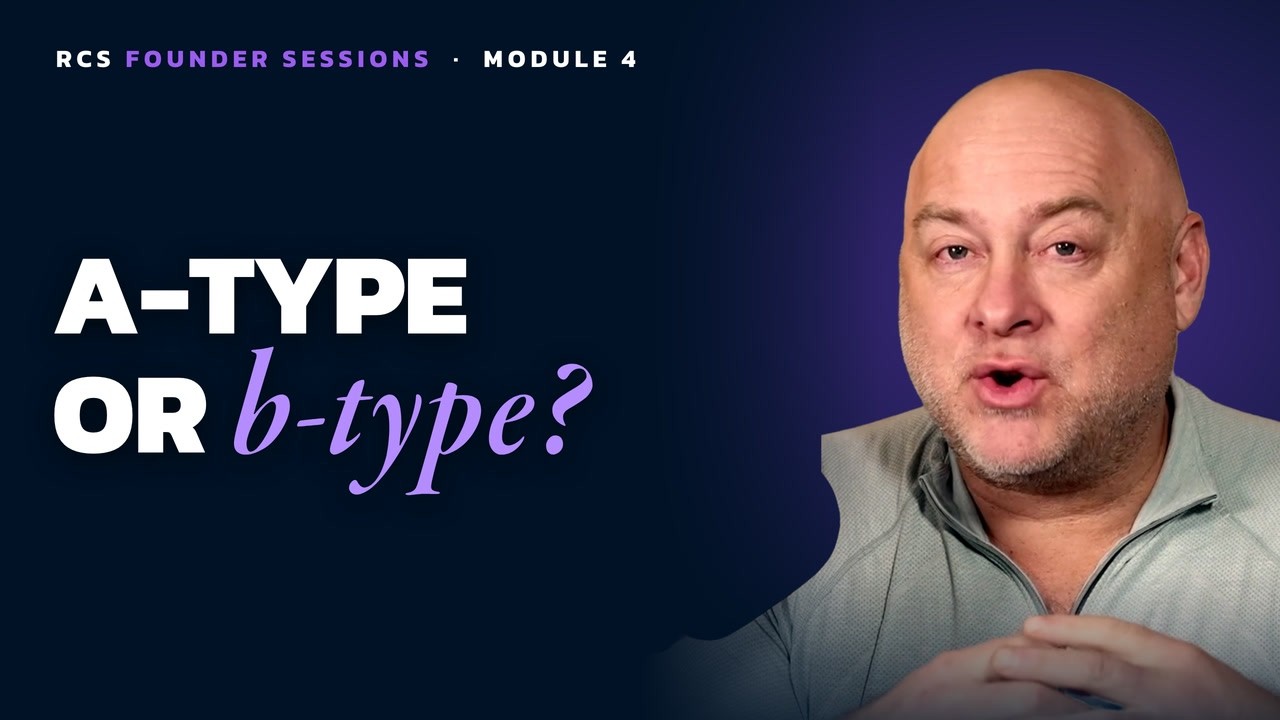
Are You an A-Type or a B-Type? Why Every Business Needs Both
There are two types of people in the world. The A-type says, "Let's move. We'll figure it out later." The B-type says, "Wait. Let's plan this through before we take action."
Which one are you? It matters more than you'd think, because a business needs both.
This is the first spotlight from RCS Founder Sessions, the Revenue 101 class I teach for entrepreneurs in Lincoln and Omaha. Each week I'll share one lesson. We're starting with the person every business depends on first: you.
Spot the A-type and the B-type
Think about relationships. They say opposites attract, and usually a couple has one of each.
The A-type leaves the place a little messier, maybe leaves their socks out. They have a higher tolerance for disorder. They're the one with the ideas: let's go do this, let's take this vacation.
The B-type keeps the place clean and organized. They're the one making sure the finances are in order and the money's saved up before anyone leaves town.
Neither one is better. Both are required to start a business. What matters is knowing which one you are, so you know your strengths and your weaknesses.
The visionary and the integrator
After Big Omaha, I went to work for Blue Box in Lincoln, one of the original subscription box companies and one of the better success stories in Nebraska. Because they had venture capital investors, they were required to run on a business operating system called EOS, the Entrepreneurial Operating System. (If you want to learn more, read Traction.)
One of the core ideas in EOS is the visionary and the integrator.
- The visionary is the A-type. Big ideas, often more than anyone can follow through on. A communicator and a good salesperson. Usually no idea how long things take.
- The integrator is the B-type. Attention to detail. Knows how long something will take, and is better with money, checklists and details.
To run a healthy business, you need both.
If you're an A-type, find your B-type
That doesn't have to be a partner. It could be an employee, an assistant, or an outside firm.
Here's how it works. The A-type has the ideas, and there will be too many of them. The B-type's job is to prioritize them and keep reminding the A-type what the priorities are. When a new idea comes up, one of the top priorities has to come off the list to make room. It's always a bit of a negotiation, but you need both sides of it.
It's freeing once you accept it
When I first learned this, it was a bit of an ego check. I thought I could build everything myself.
But once you accept it and learn your strengths and weaknesses, it's very freeing. Why fight your natural tendencies? You get to focus on what you do best.
If you're the A-type, that means the ideas, being the spokesperson for your company, owning the culture and getting your team excited. If you're the B-type, it's the priorities, the financial planning and the project management it takes to get the business off the ground.
Where video fits
Being the spokesperson is an A-type job, and these days a lot of that happens on camera. That's where we come in: we handle the planning, filming and editing so the visionary can just show up and talk about what they love.
Take the quick quiz
- Do you start before the plan is finished?
- Do you have more ideas than time to do them?
- Do you usually guess low on how long things take?
- Do you put off the budget and the checklists?
- Is your desk (or truck) a little messier than your partner's?
Mostly yes: you're likely an A-type, so who's your B-type? Mostly no: you're likely a B-type, and your A-type needs you more than they'll admit.
This lesson is one of 11 in RCS Founder Sessions, covering people, systems and the revenue funnel. Watch the whole series on YouTube, and grab the free Revenue Funnel Spreadsheet while you're there.
Get the ideas out of your head
Visionaries have plenty to say. Want the right customers to hear it? Take my free Attract More Customers class.
